Paper still follows trucks across Europe every day. The data is often already digital. The people involved carry smartphones. And the legal framework for electronic consignment notes has existed for years. So why is eCMR adoption still moving so slowly?
That was the question at the heart of Enigio and Digital Trade Works’ recent webinar on eCMR and the road to 2027.
The discussion brought together perspectives from freight forwarding, enterprise technology and digital documents to look beyond the theory: why paper CMRs remain so persistent, what is holding eCMR back, how eFTI fits into the picture, and what companies can actually do to get started.
The audience made one thing very clear from the outset: despite growing attention around digital freight, most organisations are still at the beginning of the journey.
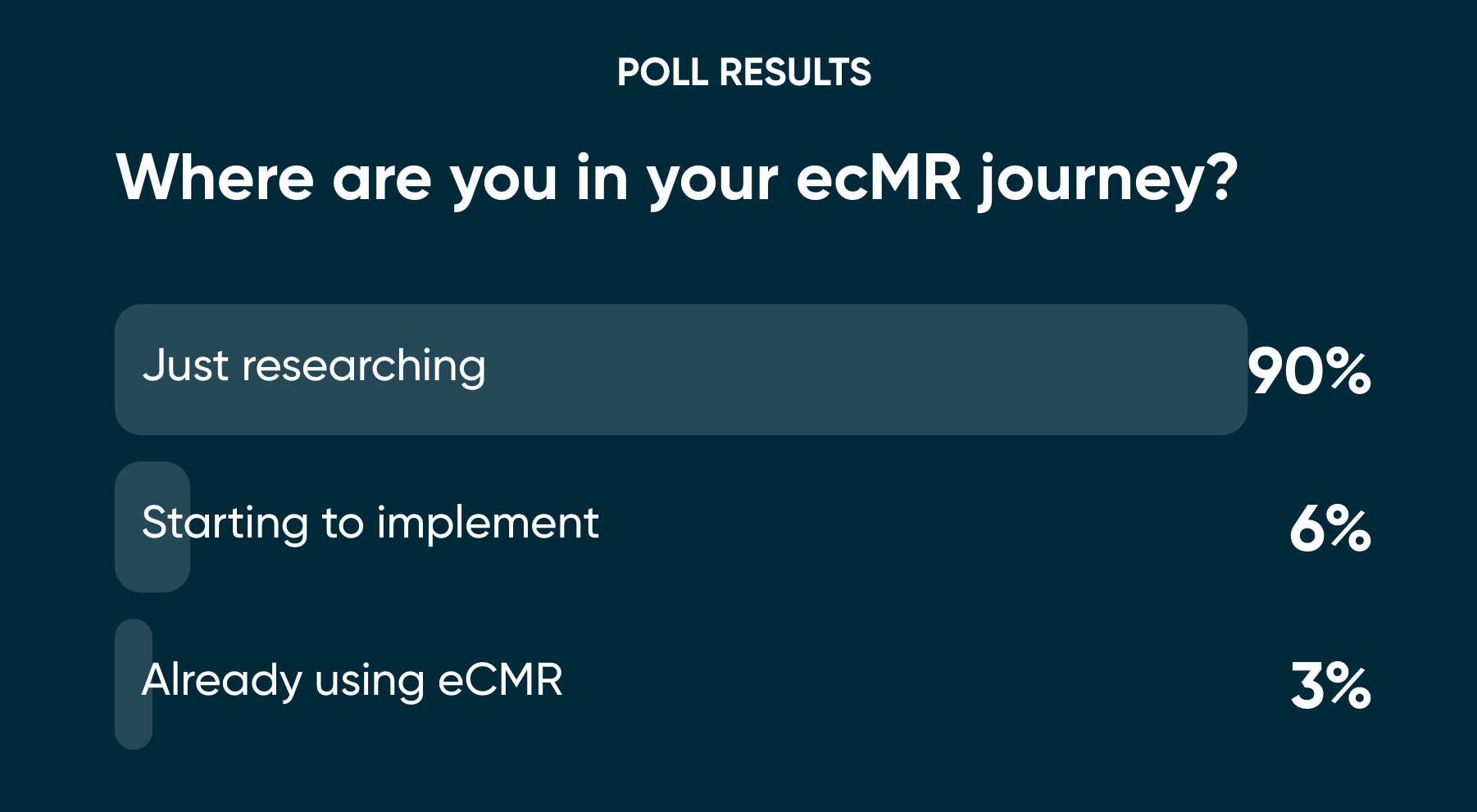
Asked where they were on their eCMR journey, 90% said they were still researching. Just 6% were starting to implement eCMR, while 3% said they were already using it.
So what needs to change?
First, why does CMR still matter so much?
For anyone working in road freight, the CMR is familiar. It is the common transport record connecting the shipper, carrier, consignee and freight forwarder, recording what is being transported, by whom, from where and to where, together with relevant instructions and remarks.
But it is more than a list of shipment data. The CMR provides evidence of what was agreed and what actually happened. It can record what was handed over to the carrier, changes during transport and, at delivery, damages or discrepancies.
In other words, it connects the physical movement of goods with the commercial and administrative processes surrounding it. And much of that process still relies on paper.
For freight forwarders, that has very practical consequences. A driver may complete or update a CMR by hand. The document passes through multiple parties. Once the goods arrive, the signed CMR then has to find its way back, perhaps as a scan or email attachment, and sometimes as the original paper itself.
The goods can therefore reach their destination before the information needed to close the shipment does.
That matters financially too. As Christian Baumbach, Head of Overland at Fr. Meyer’s Sohn (FMS), explained:
“The goods have been delivered and it takes sometimes quite a long time [before] we receive the signed CMR. And this is a base most likely for us for invoicing the customer.”
What sounds like a paperwork problem can quickly become a cash-flow problem.
The strange part: much of the data is already digital
The persistence of paper becomes harder to explain when you look at where the information starts.
Dominic Regan of Oracle pointed out that the majority of the information expected on a CMR is already available electronically, whether in ERP systems, transportation management systems or warehouse management systems.
Companies can therefore begin with digital data, print it onto paper, add more information manually as the goods move and then have to get that information back into digital systems afterwards.
The problem becomes particularly obvious when something happens en route. A driver might use a mobile phone to photograph proof of delivery or damage, for example, while the actual CMR continues its journey on paper.
And simply replacing that piece of paper with a conventional PDF does not necessarily solve the problem.
An eCMR needs to continue evolving during the transport. Signatures, remarks and other information may need to be added as the goods move without compromising information already recorded. The electronic CMR also needs to be available to present to relevant authorities when required.
As Göran Almgren, Co-Founder and Director of New Business at Enigio, put it:
“Things happen during the transport and then you have to populate the CMR with that data that is needed to have all the information when the goods come to the final destination.”
So the real question is not simply how to turn a CMR into a digital file. It is how to make the document digital without losing the functions that made the paper document useful in the first place.
So why is adoption still so slow?
The webinar audience had some clear views.
Asked why they thought eCMR adoption remained slow, 30% pointed to a lack of interoperability or standards, while another 30% said nobody was forcing the change. A further 15% cited partners not being ready and 15% legal or regulatory uncertainty. Interestingly, only 4% said they simply did not see the ROI yet.
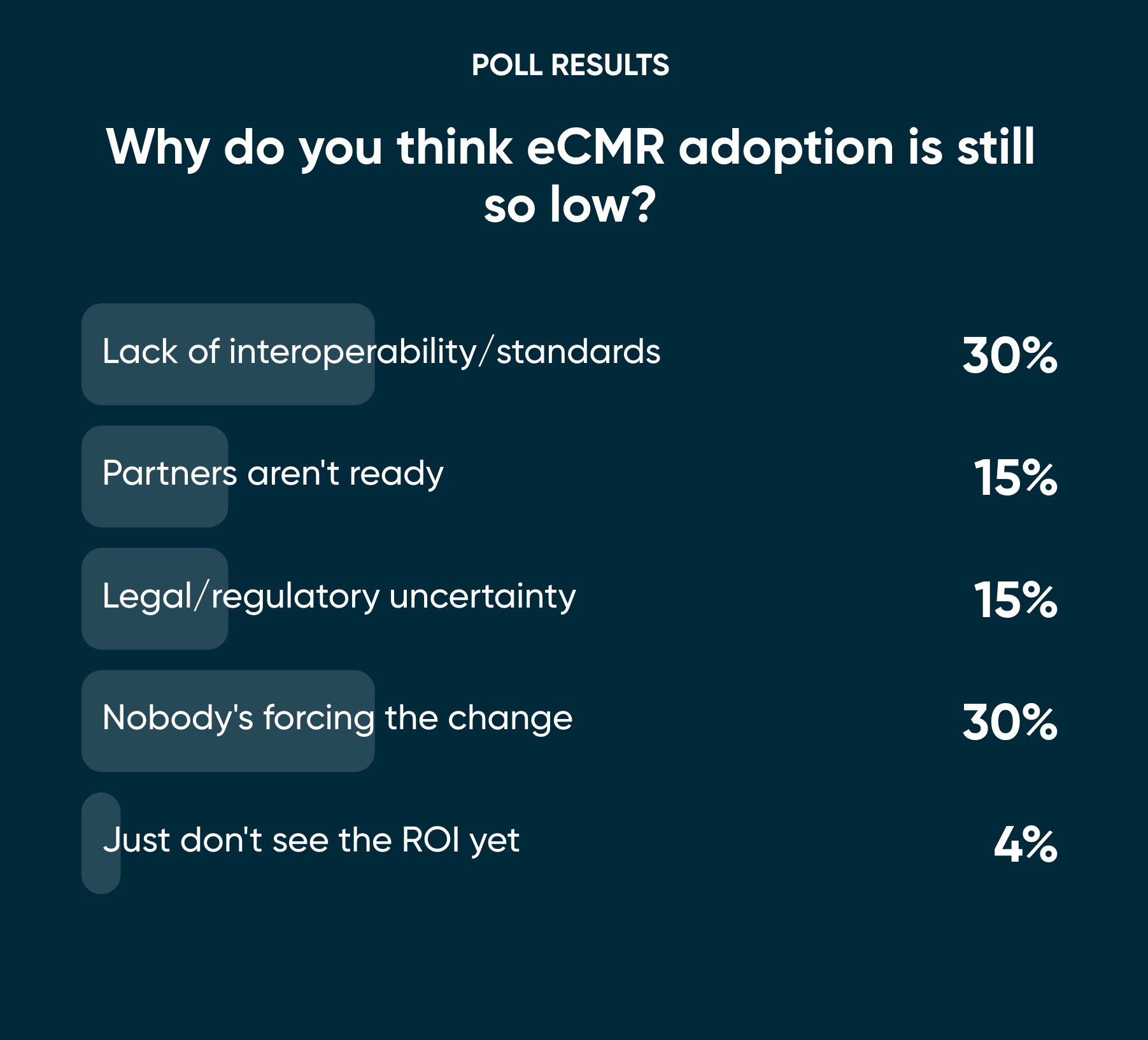
That last number matters. The problem does not appear to be simply convincing people that digitalisation has value. The bigger questions are how organisations participate, whether their partners can participate with them and what will finally create enough momentum to move from interest to implementation.
Asked about the biggest blocker for their own organisations, respondents were even more specific: 36% cited getting partners onboarded and another 36% a lack of internal priority. Internal system integration accounted for 14%, while not a single respondent selected cost.
That aligns closely with what the speakers see in practice.
For Baumbach, one of the biggest complications is fragmentation. Road freight brings together organisations with very different levels of technological maturity, from large international companies to small carriers, subcontractors and individual operators.
“There is a big gap in knowledge about eCMR,” Baumbach said. “We talk to a lot of partners of ours and for them, they never heard about the eCMR even though it’s for a long time in place.”
A single shipment can pass through several of these organisations, and they are unlikely to share the same IT environment. Some carriers have their own systems. Others may conduct much of their work manually.
That creates a very practical test for any eCMR solution: it cannot work only for the most digitally sophisticated company in the chain.
eFTI and eCMR: related, but not the same
Regulation could provide some of the push the market has been missing.
The EU’s Electronic Freight Transport Information regulation, or eFTI, requires member-state authorities to be able to accept regulatory freight information electronically from July 2027, as Regan explained during the webinar. Much of that information overlaps with the data contained in a CMR.
But eFTI and eCMR are not interchangeable.
Broadly, eCMR concerns the electronic consignment note used between commercial parties in road transport, while eFTI is concerned with electronic freight information made available to public authorities. Their datasets overlap substantially, which creates opportunities to reuse structured information rather than maintain separate paper and digital processes.
If that distinction sounds obvious to people immersed in digital freight, it evidently is not obvious to everyone.
When webinar participants were asked whether they knew the difference, just 23% confidently answered yes. Another 8% said “I think so?”, while 58% answered “Nope” and 12% “Between what?”
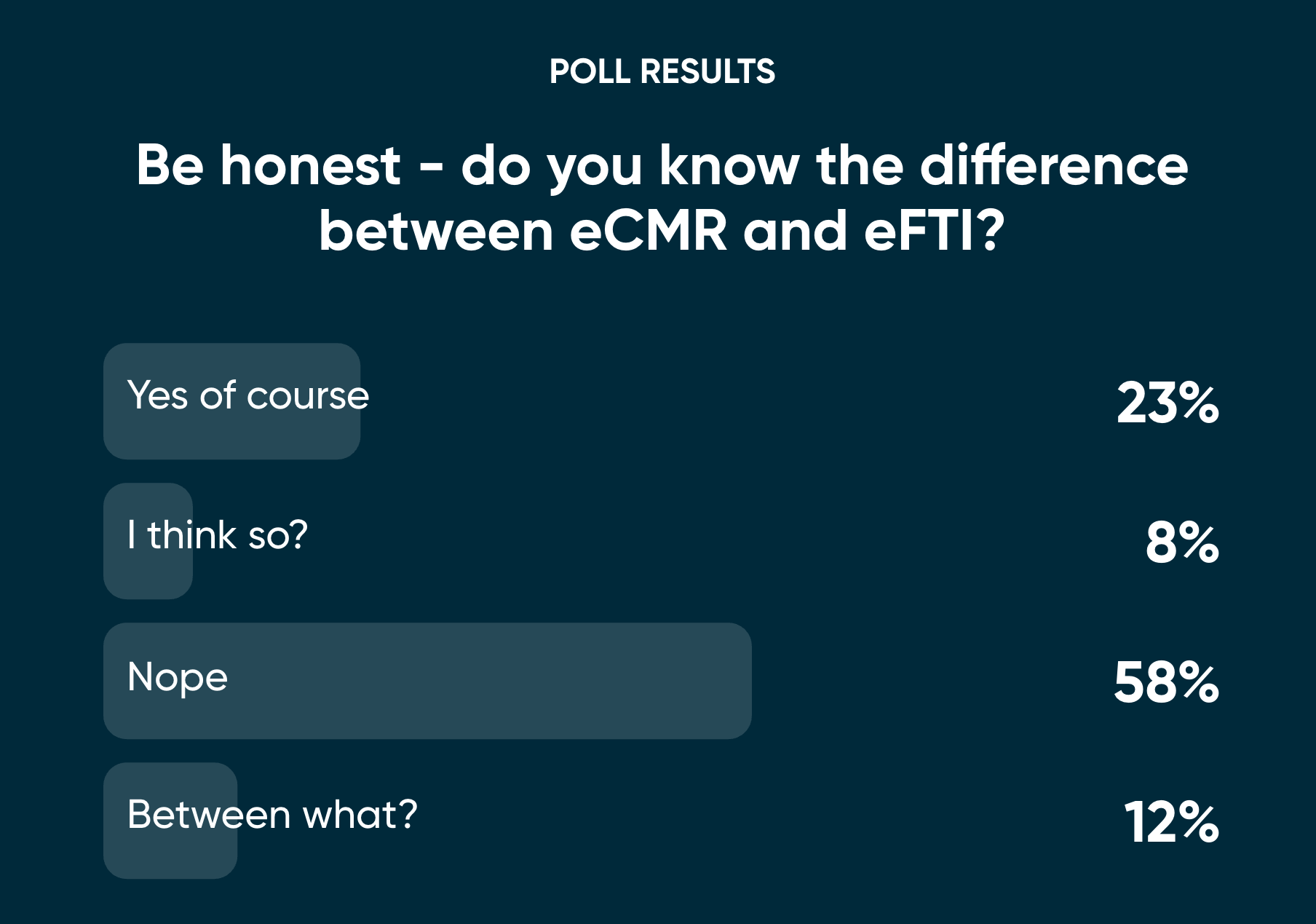
That's more than an amusing poll result. If the industry is approaching a significant regulatory milestone while much of the market is still getting to grips with the terminology, then awareness itself remains part of the adoption challenge.
Still, the direction of travel is increasingly clear: towards electronic exchange and, crucially, structured data.
As Almgren noted:
“The key thing is really structured data. If you have structured data and you know one standard, then you can move that into another standard.”
The business case goes beyond replacing paper
This is where the discussion around eCMR becomes more interesting.
Once transport information is digital and structured, organisations can begin to do more with the data than simply view an electronic version of a document.
Regan pointed to opportunities for automation around document ingestion, anomaly checking and downstream processes. If the right information arrives as expected, that can enable a subsequent process to begin. If something is missing or inconsistent, that can instead be identified and handled.
“If you have accurate, timely, granular data, you can do an awful lot of things,” Regan said. “If you’re lacking that data, it can be a challenge.”
The importer offers another example.
Warehouse systems can have a precise digital record of what inventory they contain, but when a truck arrives, information from the CMR may still need to be keyed into those systems manually. An eCMR carrying up-to-date structured information creates the possibility of using that data directly rather than re-entering it from paper.
That is a more meaningful business case than simply “saving paper”.
What does the ROI look like in practice?
One audience question went directly to Baumbach: what immediate business benefits had FMS actually seen from its first eCMR pilot?
His answer was refreshingly mundane, and that is precisely why it matters.
“We reduced the manual work because we had seen immediately what had happened during the transport,” Baumbach said. “When we unloaded it, we already had the signed CMR so we were able to immediately invoice the customer.”
There was no waiting for the paper CMR to return. No repeatedly handling the same file. No manually taking information from the document before the transport file could be closed.
Baumbach summarised the change rather neatly: “Transport done, file closed.”
That gets closer to the real ROI of eCMR: less manual handling, faster access to transport information and the ability to move immediately into the next business process.
It also puts the audience's earlier answer into perspective. Only 4% said they did not see the ROI. The bigger obstacle appears to be making the transition workable across an ecosystem.
Digital cannot mean creating another closed network
That brings us back to the biggest practical barrier identified in the polls: getting partners onboarded.
If solving the paper problem requires every carrier, forwarder, shipper, consignee and subcontractor to join the same platform before they can participate, the industry risks replacing one adoption problem with another.
Almgren argued that the transition should change as little as possible for the people actually using the CMR:
“Keep the process intact. Just remove the paper, keep everything as similar as possible so that the truck driver recognises it.”
That includes avoiding unnecessary onboarding.
With Enigio's approach, a truck driver or importer does not have to be onboarded onto Enigio's platform simply to receive and manage an eCMR, Almgren explained during the webinar.
For a fragmented ecosystem such as road freight, that distinction matters.
The digital document needs to be able to move across organisational and system boundaries, just as its paper predecessor does, without expecting every participant to adopt the same IT environment.
Don’t wait for the whole industry. Start with one lane
Perhaps the strongest point of agreement among all three speakers was also the simplest: start small.
Not with an organisation-wide transformation programme. Not by waiting until every trading partner is ready. And not by attempting to digitise every route simultaneously.
Start with a pilot.
Almgren described a recent pilot where eCMR data was initially keyed in manually. That meant the company could test the document on real transports without first having to undertake an IT integration project. Integration with a TMS or similar system becomes relevant when moving into higher volumes.
Baumbach recommended much the same from the freight-forwarding side: choose a good customer, select one regular lane and work with the people actually involved in that chain.
“Start small, talk to your customers. Talk to the subcontractors, and then just start with single transports.”
In FMS’s first pilot, the carrier even took a handwritten CMR along as a backup.
There is something instructive in that.
Digitalisation does not have to mean waking up one Monday morning and discovering that the entire road-freight ecosystem has changed. Paper and digital processes can coexist during the transition while companies prove what works and expand from there.
Regan put the alternative simply:
“The perfect is the enemy of the good.”
His advice was to map the stakeholders along a route, identify willing participants and understand what each of them gets from making the change. A carrier or subcontractor that can see a concrete benefit, such as quicker payment or less administration, is more likely to become an advocate rather than seeing eCMR as another administrative burden.
From research to real transports
Perhaps the most revealing webinar poll was the simplest: 90% of respondents were still researching eCMR.
That is a sizeable gap between interest and action.
But the other poll results provide some clues about how to close it. Cost was not the issue for the respondents. Nor was a lack of perceived ROI the dominant concern.
Instead, the recurring themes were interoperability, partner participation, internal priority and uncertainty about the wider regulatory landscape.
Those are not problems that will disappear because one company finds a better piece of technology. Road freight is an ecosystem, and the transition has to work across organisational boundaries.
But that does not mean every participant has to move at once.
It can start with one customer, one willing group of partners and one lane.
The payoff can be equally concrete: the goods arrive, the signed transport information arrives with them, the file can be closed and invoicing can begin.
As Baumbach said at the end of the webinar:
“Just start a pilot. It’s working, and let’s start to reduce the manual work and to digitalise road transport.”
2027 may add regulatory momentum. But organisations do not need to wait until then to find out whether eCMR works for them.
The data is already largely digital. The inefficiencies of paper are already visible. And the first step can be considerably smaller than many organisations imagine.
Still have questions? Watch the full webinar below.