The eUCP is older than the iPhone. The ICC published its rules for electronic presentation under letters of credit in 2002, and for most of the time since, there were almost no transactions to show for them. Documents were printed, couriered, checked and couriered again. Sometimes they arrived after the goods did.
That has changed. In the past twelve months, Yapı Kredi completed Türkiye’s first fully digital LC presentation, Société Générale and Lloyds closed one of the first fully digital LCs between the UK and France, and Commerzbank and Lloyds completed a UK–Germany LC where every document moved digitally instead of by courier. Just to name a few!
On 24 November we put four of the banks behind these deals on one panel: Lloyds, Société Générale, Commerzbank and Swedbank. Moderator Merisa Lee Gimpel of Digital Trade Works opened with the line that stuck: “The rulebook finally has deals.”
What follows is what they told us, in their own words, plus what our live audience said in five polls.
Key takeaways
- Start easy. Pick a flow with no document of title and make the first deal a simple one.
- Speed is the headline. Financing is the prize. Lloyds’ UK–India deal was accepted in 4 days instead of an estimated 22, and the exporter got paid 26 days before maturity.
- A discrepancy now costs hours, not days. Without a courier in the loop, a fix goes round the same day.
- Only the courier changes. SWIFT, back-office systems and compliance stay exactly where they are.
- Nobody went back to paper. Lloyds reports a 100% hit rate: no client or counterparty has reverted.
- Client demand is not the main barrier. Only 14% of our audience named it. Counterparty readiness (31%) and internal systems (30%) came first.
- The industry wants a directory. 86% said a live Digital Trade Bank Directory would be very or extremely useful.
Why now: an old rulebook, a new law
The eUCP is a short supplement to the UCP, which Angela Koll of Commerzbank describes as “like a bible for each and every doc checker”.
Angela chairs the ICC working group on the practical application of eUCP. By her count there are “only 14 articles”, covering what an electronic record is, how to present one, how signatures work and how to examine it all. S
hort, but she calls it essential: “a common base for all banks which deal with electronic presentations.”
The other half of the story is the law. MLETR-aligned legislation in the UK, France and other markets now gives digital originals of documents of title and negotiable instruments the same legal standing as paper. Christian Cazenove of Société Générale put it first on his list of enablers: both countries, UK and France, had adopted MLETR.
Where the market stands today
Before the case studies, Merisa asked the room whether their organisation had completed an electronic presentation under an LC. 23% said yes, they are live. 14% have run pilots. 27% are exploring, and 36% have not started.
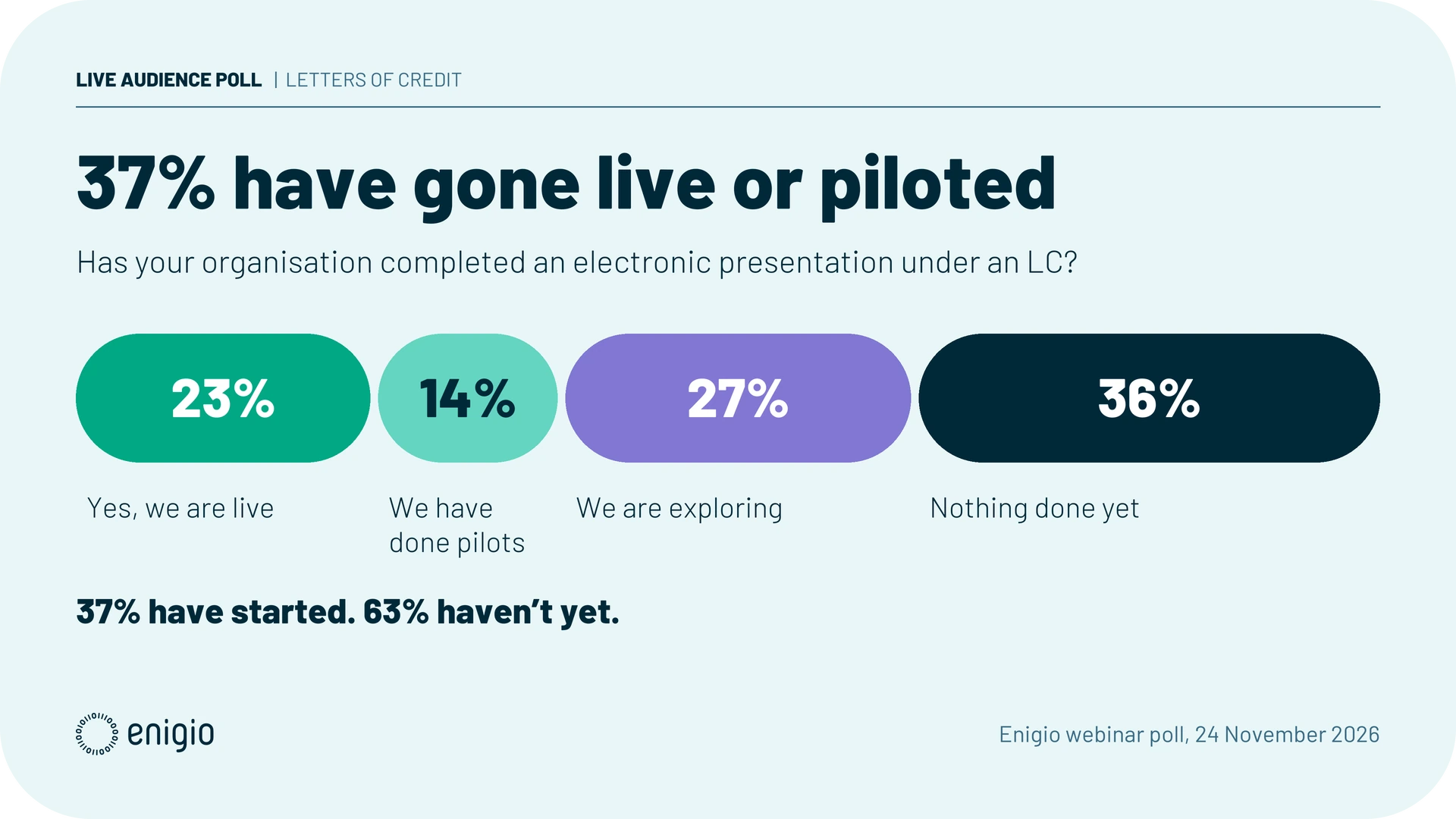
More than a third are already doing it. Nearly two thirds are still deciding. That is why we wanted practitioners on the panel and not theory.
Four deals, four corridors
| Bank | Corridor | What happened |
| Lloyds | UK and India | A West Yorkshire exporter of laboratory equipment, under an LC issued by an Indian bank. Documents accepted 4 days after the digital presentation was created, against an estimated 22 on paper. Four courier journeys removed. |
| Société Générale (with Lloyds) | UK and France | A real transaction between separate banks and separate corporates, supporting an equipment export. Not one document printed. Processing time cut from 6 to 7 days on paper to a couple of days at most. |
| Commerzbank (with Lloyds) | Germany and UK | Conveyor systems from a German exporter to a UK importer, by road. Invoice, packing list, CMR and insurance certificate presented digitally. Documents reached the importer in 8 days instead of 15, 47% faster, including a correction and resubmission. |
| Swedbank | Sweden and China | Live from day one, with no pilot phase. Documents travelled from Enigio trace:original to TradeGo through the interoperability link between the two. |
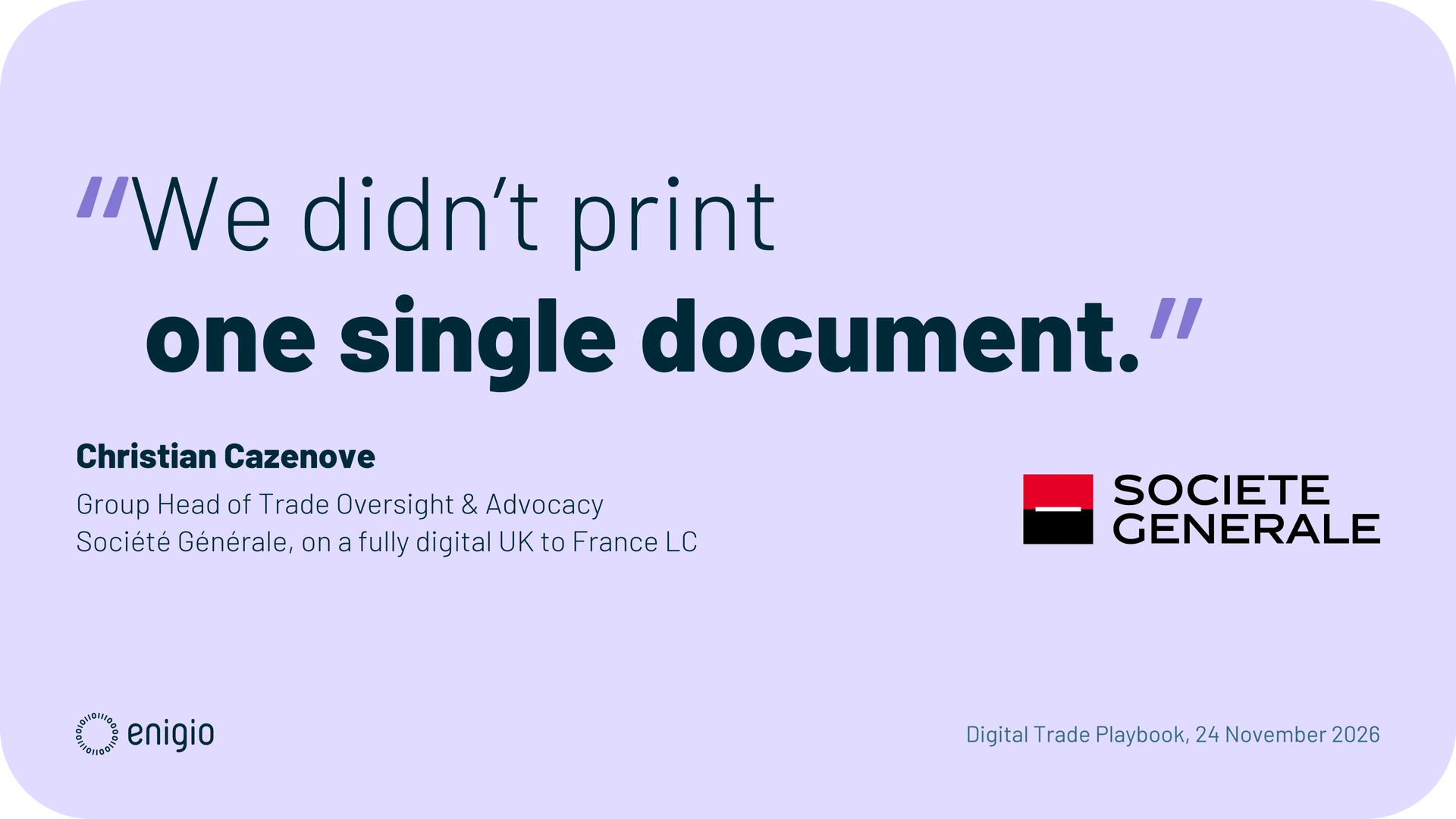
Each deal used digital originals that moved from exporter to banks to importer inside digital envelopes, together with the supporting documents. Nothing to print, scan or courier, and no closed platform to join. Christian Cazenove put it plainly.
Lesson one: start easy
“We like easy solutions, especially in trade finance.” — Angela Koll, Commerzbank
Commerzbank’s deal with Lloyds was road transport, so no bill of lading to worry about: just a CMR and a handful of straightforward documents. “It’s nice to start easy, to be honest,” Angela said. Lloyds’ UK–India deal followed the same logic. James Mortimer was upfront about it: “The example here is deliberately simple.” An invoice, a packing list, an insurance certificate, a certificate of origin and an air waybill, with no document of title to change hands.
Merisa’s tip for choosing your first one: look across your flows for the transactions that do not involve a document of title. Air waybills and sea waybills are good places to start.
One step you cannot skip is the LC itself. In the Lloyds and Commerzbank deals the credit was amended to be subject to eUCP, with clear wording on how and where the electronic presentation would be made. Angela’s advice: work out that wording with a counterparty who has done it before. For Commerzbank that was Lloyds. “We could easily move from theoretical discussions to more practical discussions.”
Lesson two: speed is the headline, financing is the prize
James Mortimer’s UK–India deal is the cleanest illustration of what speed is worth.
“From [the exporter] creating the digital presentation to the issuing bank accepting the documents took just 4 days. We estimate the equivalent paper process would have taken around 22 days.”
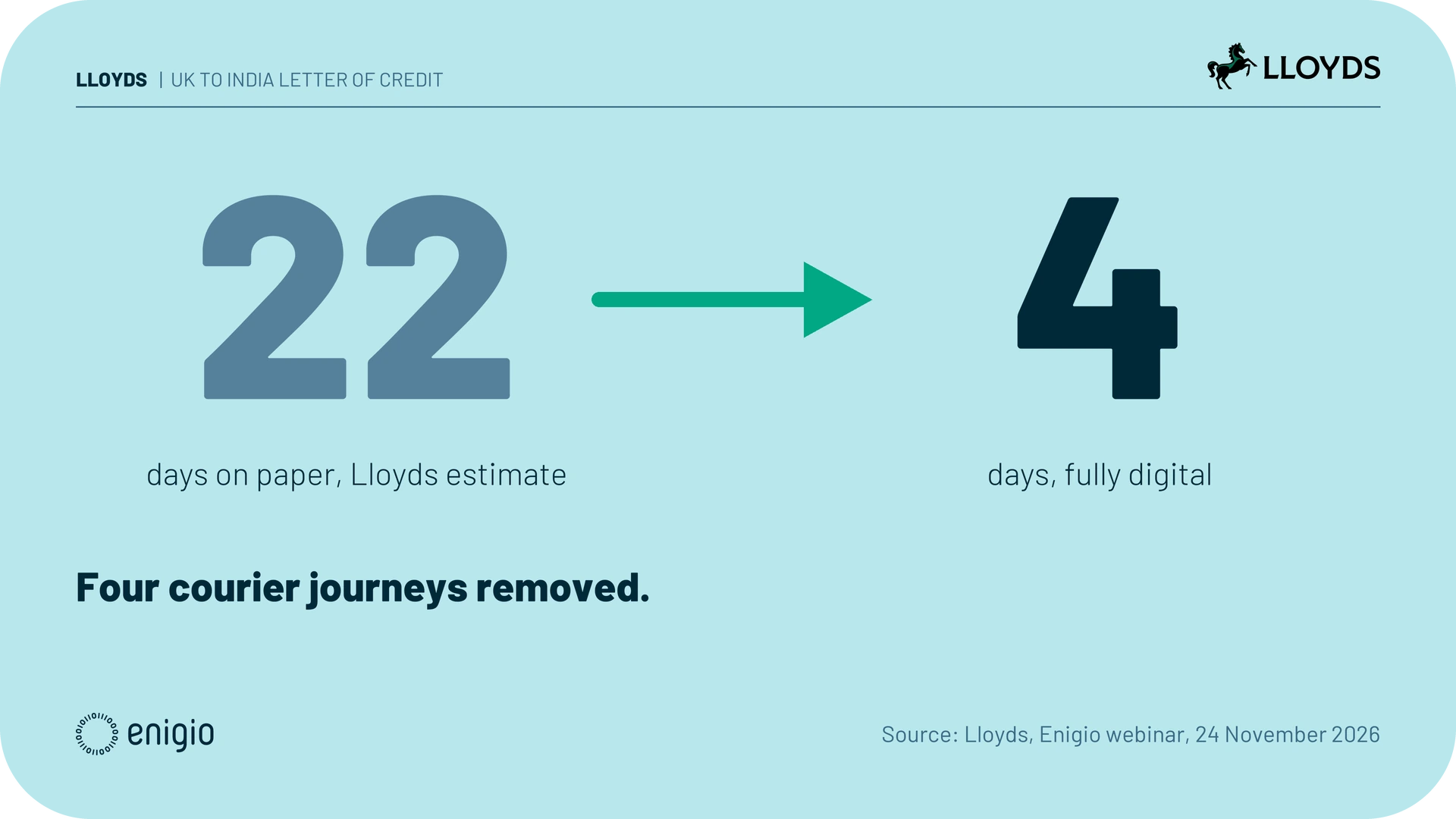
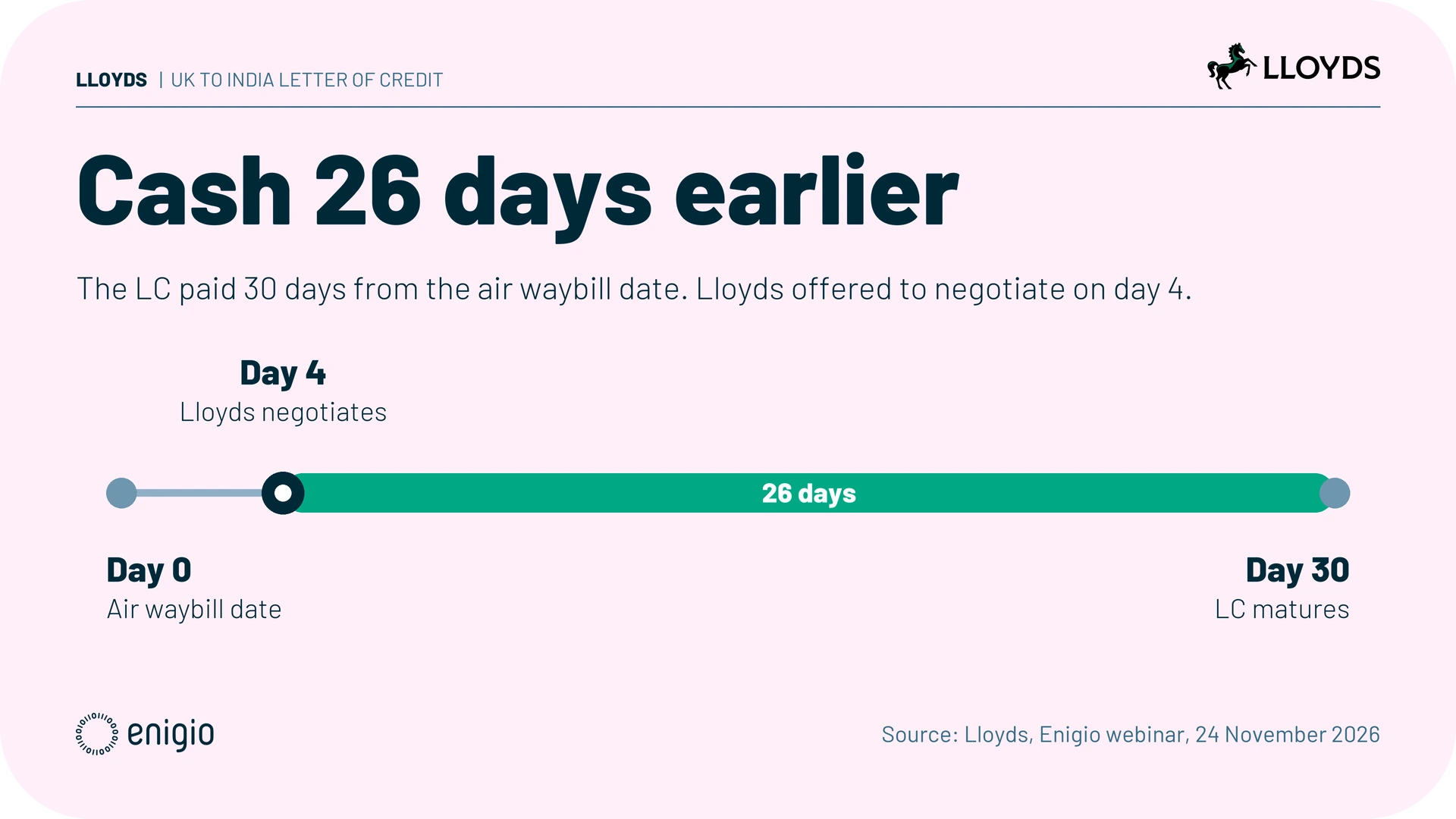
The interesting part came next. The LC was payable 30 days from the air waybill date. Because the presentation was done so quickly, Lloyds could offer to negotiate just four days after the air waybill date, so the exporter could access its cash 26 days ahead of maturity.
“The speed of the digital process created a financing opportunity that effectively wouldn’t have existed in the paper world,” James said.
The exporter’s view was that on paper, the remaining financing period would have been too short to be worth doing.
“Digital trade isn’t just about replacing paper with electronic documents,” James said. “It compresses the transaction timeline.” The client’s own verdict, as relayed by James: “It couldn’t have been easier. It was quick, simple, and certainly cheaper for all parties involved.”
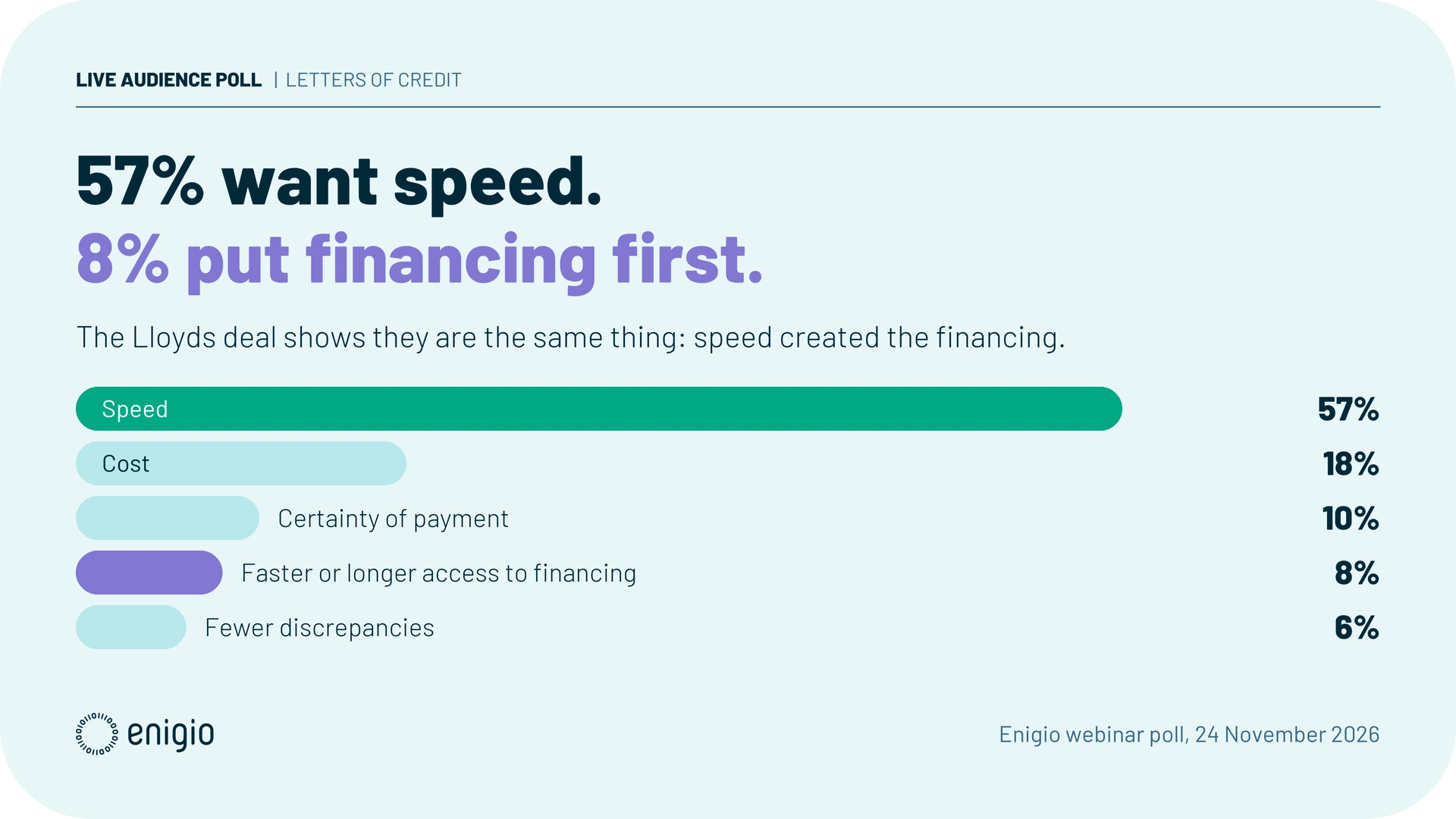
The poll suggests the audience feels the speed but has not quite joined the dots. 57% picked speed as the benefit that matters most to their organisation. Cost came second at 18%, then certainty of payment (10%), faster or longer access to financing (8%) and fewer discrepancies (6%).
Importers gain too. James pointed out that documents arriving well ahead of the goods reduce storage and demurrage risk. The one watch-out is sight LCs, where faster presentation can also bring the payment obligation forward. Lloyds structures around it so the importer keeps its normal payment cycle.
Lesson three: a discrepancy costs hours, not days
First presentations are often discrepant. The Lloyds, Société Générale and Commerzbank deals all had one. On paper, the fix means documents going back and forth by courier. Here, James said the exporter “cured the discrepancy and re-presented the documents within hours.”
Christian Cazenove described the same thing from the Société Générale side. The client is not based in Paris, so on paper they would have received documents twice by DHL or another courier, across at least three shipments.
“Instead of having, for each shipment, 4 to 5 days, it only took us less than 1 day.”
Only 6% of our audience picked fewer discrepancies as the benefit that matters most. Christian was surprised by that. His view: digital does not just speed things up, it opens the process to automation and lets exporters send a more compliant set of documents in the first place. “The discrepancies are considerably reducing by going digital.”
Lesson four: only the courier changes
“We just replaced the courier by an electronic envelope.” — Angela Koll, Commerzbank
All four banks said some version of this. Christian was specific about what stays: “What is not changing is the SWIFT messaging framework, those MT 700s. This doesn’t move.” Angela added that the LC still arrives by SWIFT and still goes through the same back-office systems and compliance checks.
What does change is the courier, and the time it eats. Christian talked about moving from 6 to 7 days, sometimes more than 10, to a few days at most, with the beneficiary getting paid earlier. What it asks of the bank is sign-off, training and a change of mindset. Société Générale needed approval from legal, risk and finance, trained its back office on the eUCP and set up an internal working group. “It’s not rocket science, to be honest,” Angela said, “but you need to change the mindset a little bit, because we are all in trade finance so much used to paper documents.” Every action also lands in an audit trail, which Angela said gives “really security”.
The team Christian was least sure about was the back office, which has worked with paper for decades. His verdict: they “not only embraced the digital process, but now are becoming sponsors of this solution.” In fact, “they’re chasing me” for more transactions.
Asked what surprised them, Lloyds and Swedbank both pointed to the client experience. James Mortimer’s answer was short.
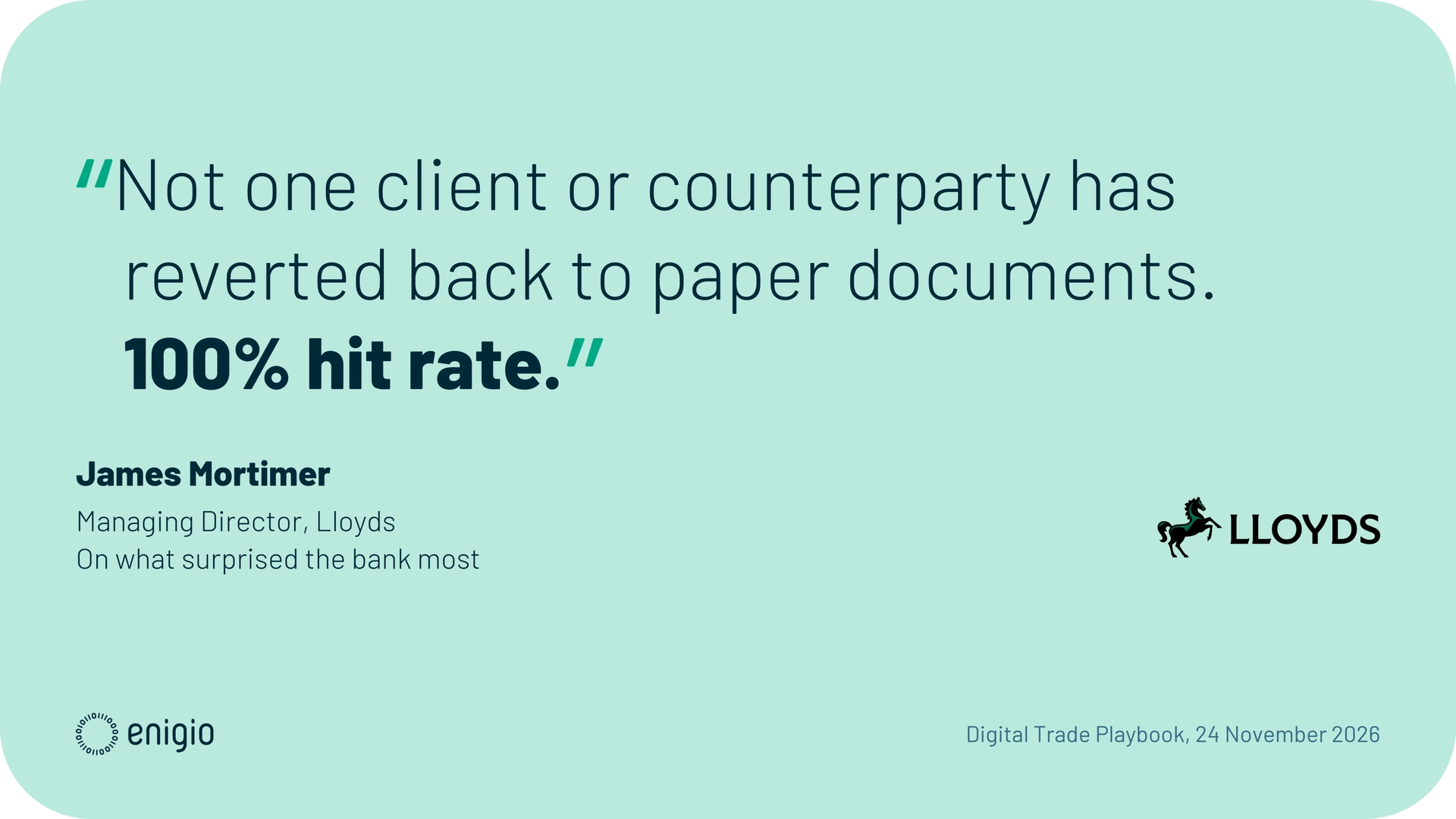
“That surprised us,” he added.
Christer Norén of Swedbank said simplicity: the client needed no integration or implementation, “and in the transactions that we did, our client didn’t have to pay anything.”
He was honest about the catch. Change management, inside the bank and outside it, still takes some convincing.
Lesson five: open beats locked in
None of these deals needed anyone to join a closed platform.
Merisa explained what that means in practice: only the party starting the chain, the one creating the documents, needs access to Enigio. Everyone further down can receive the digital envelope, pass it on, and next time be the one who prepares it.
“That’s the nice open nature of this,” she said. A network effect, built one deal at a time.
Swedbank’s deal shows how far that goes. Christer’s team used Enigio trace:original together with the interoperability link to China’s TradeGo, where many Chinese banks and corporates already handle their trade documents. They skipped the pilot altogether.
“We’re not really so keen on doing any pilot or any POC phase,” he said. “We started, to be honest, with a live transaction from the get-go.”
For that to work, every party in the deal had to share the same goal. At the follow-up meeting, the client said this:
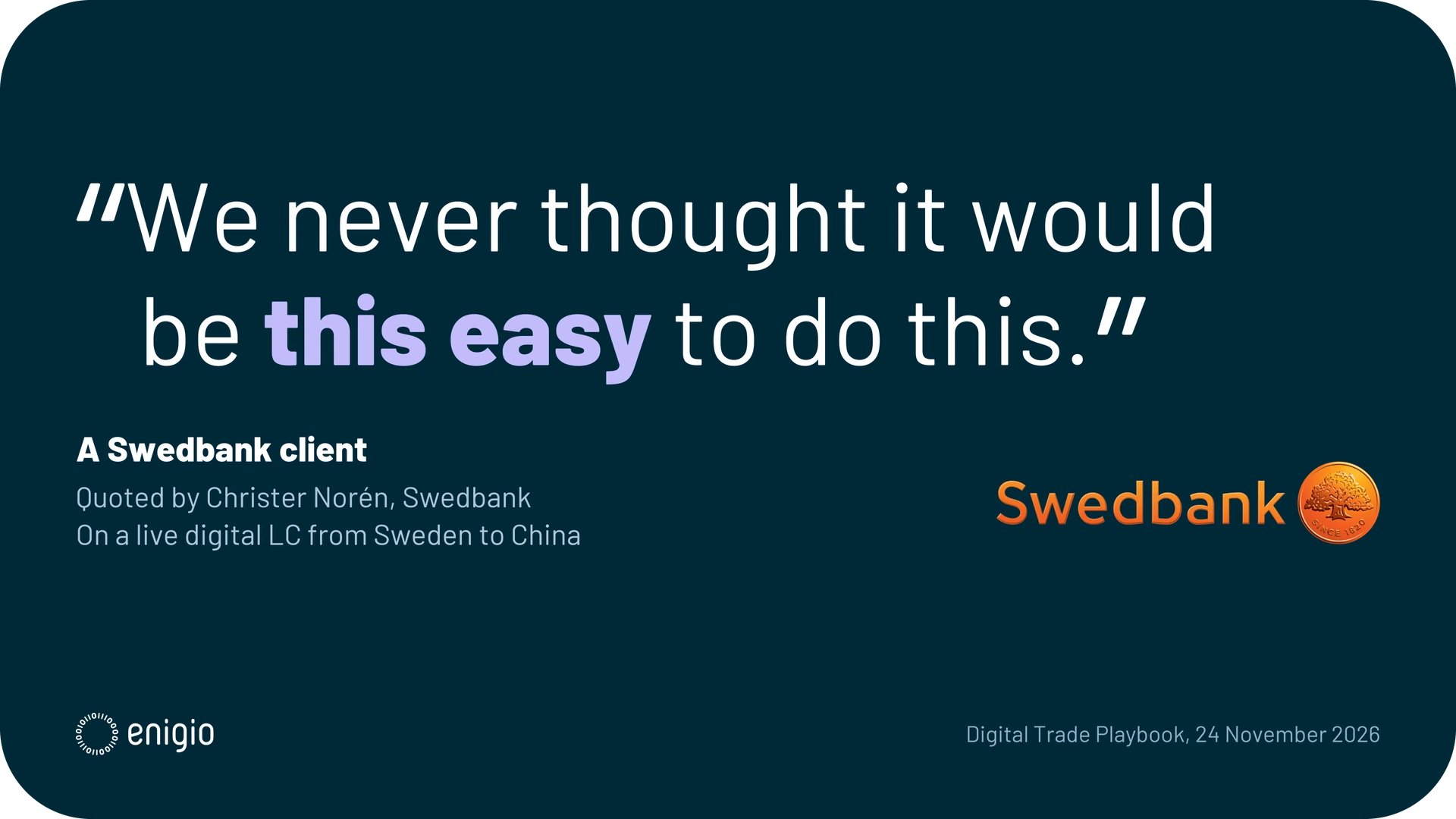
“So for me as a banker,” Christer added, “a happy client is a happy life, right?”
James noted that Lloyds pioneered the interoperable electronic bill of lading between Enigio and TradeGo in 2024.
“We know Chinese banks and corporates are unlikely to sign up to European solutions, so it’s vital that we have that interconnected.” And in the Société Générale deal, Lloyds’ importer client issued five LCs to different suppliers: digital presentation worked on three of them.
What's holding back adoption
Electronic presentation is not routine yet, and Christian was the first to say it.
“We are quite far from the routine, actually. As long as we deal with only 10, 15% of digital transactions, I’m not sure we can talk about routine.”
We asked the audience what the biggest barrier is.
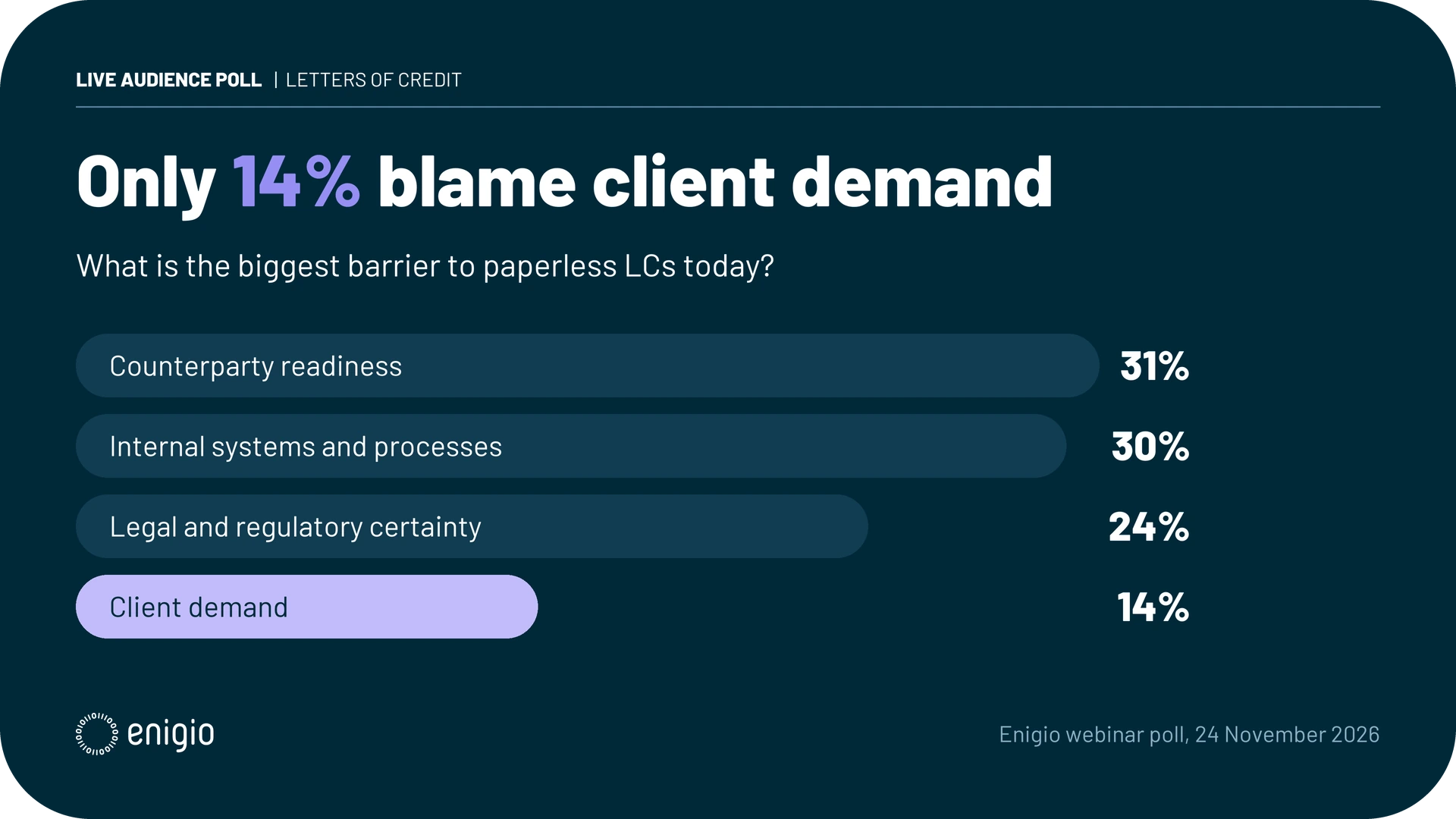
Counterparty readiness (31%) and internal systems and processes (30%) came first, followed by legal and regulatory certainty (24%). Client demand came last, at 14%. The plumbing is the problem, not the appetite.
The panel’s own list of what is missing was consistent with that:
- More real transactions to convince the doubters. “We are lacking real transactions” (Christian).
- Appetite, especially from corporates. “Digitalisation is a question of mindset” (Christian).
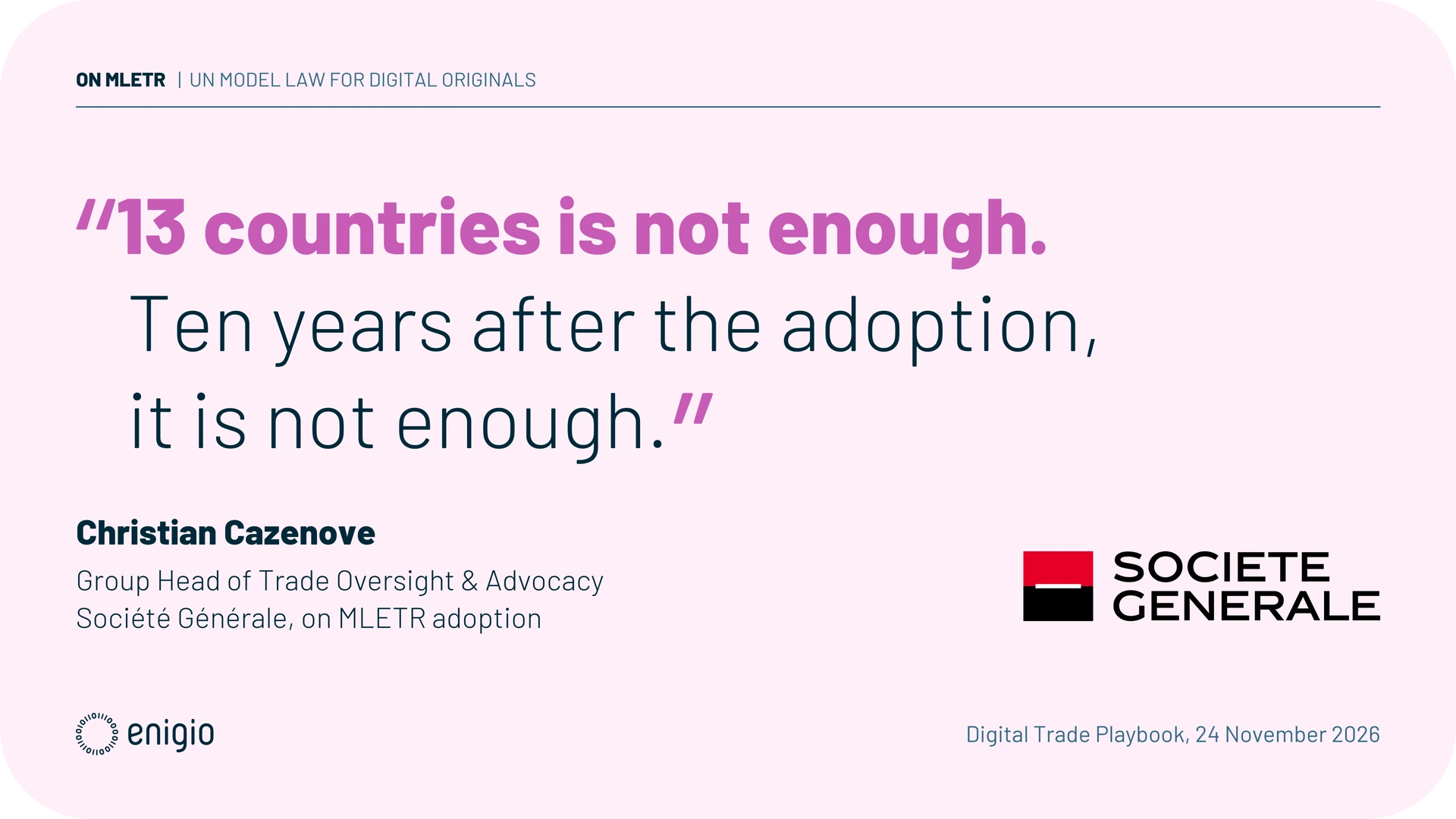
- More MLETR adoption. The UN adopted the model law in 2017, and only 13 countries have adopted it so far.
- Regulatory comfort. Commerzbank has spoken to central banks in several countries, together with the EU. Angela: “If you have convinced the central bank of a certain country, you can be sure that you will be able to do some transactions with banks in that country.”
- Standards and interoperability. “If you have a standard and you adopt the standard, you are able to also have interoperability” (Angela, on DCSA for electronic bills of lading).
- Budget, and not just for IT, to carry the change at scale (Christian).
Where to start with digital LCs
If you take one thing from the session, take this checklist, assembled from what the panel did:
- Pick a flow without a document of title. Air waybill, sea waybill or CMR.
- Find a committed counterparty, ideally one who has done it before.
- Amend the LC so it is subject to eUCP and says clearly how and where the electronic presentation is made.
- Get legal, risk, finance and operations in the room early, and train your back office.
- Go live. Swedbank went straight to a live transaction, with no pilot phase.
Christer closed the session with his own advice to the audience: find committed partners, start small and simple, and then, with a nod to a famous sportswear brand, “just do it.” Swedbank’s own start was a client, Ericsson, and direct guarantees to the Philippines, which was basically an email link.
Merisa added that this space is more collaborative than people assume.
“Sometimes everyone thinks, oh, banks are competing with each other, but actually in this space, I heard this from many banks: we really want to collaborate on this. When everybody goes digital, then we all win.”
Missed the session? Watch the recording on the webinar page.
Thinking about your first digital presentation? We're ready to help. Get in touch below!