The internet has been in the public's hands for over 30 years now. All this time it was igniting a digital revolution that has reshaped nearly every aspect of our lives.
From biometric passports to contactless payments, we glide through borders with digital dexterity. The goods themselves move through an increasingly digital world too – state-of-the-art container ships navigate with GPS precision, robots run entire warehouses, and automated cranes load and unload cargo without a human hand in sight. Yet, when it comes to the paperwork trailing all that cargo, we're still wrestling with reams of paper.
Which begs the question...why?!
Even banks – bastions of data security and efficiency – have mastered digitalisation in some aspects decades ago, creating SWIFT, a standardised system that moves trillions securely across the globe with the push of a button. They understood the assignment (or at least parts of it).
Meanwhile, cargo ships, trains, and trucks still traverse the globe, weighed down by paper trails vulnerable to loss, delay, and manipulation.
Essential trade documents, the lifeblood of commerce, still remain trapped in a labyrinth of manual processes and the world of ink and paper. (The thousands of scanned documents and PDFs cluttering your computer – simple files with no data embedded behind them – don't seem to be helping either, do they? But more on that later.) Layers of complex regulations mean these documents must be painstakingly processed and checked, adding friction to an industry that thrives on speed.
For a world that depends on trade, it's a paradox. Digital solutions exist. The question is, why hasn't trade caught up yet?
In this guide, we will break down the essentials of digital trade documentation, analyse how digital trade documentation reduces costs, saves time, and levels the playing field, and why your business should embrace it.
Wherever your business is starting from, the technology to get going – and to scale – already exists. The only real question is when you begin.
Setting the scene: A typical scenario
Daniel runs a boutique coffee export business out of Kenya. His beans are top-tier, but his paperwork is a nightmare.
Every shipment means weeks of delays, stacks of documents, and endless back-and-forth with banks and customs officials. The coffee world moves fast. But Daniel's business, thanks to outdated trade processes, doesn't.
Enter the future where digital-native trade documents run the show. They're instant, secure, and legally recognised.
Cut to “future” Daniel.
He ditches the paper trail for electronic bills of lading and e-certificates of origin. Payments move faster with e-invoices and e-signatures, and customs stops being a bureaucratic nightmare. With interoperable digital trade systems, his documents are valid everywhere and read by most software programmes: no closed networks, no compatibility headaches. He can use one solution; his trading partners can use another. But everything just works.
And the result? Daniel's shipments clear in hours, not weeks. Payments flow smoothly. His business operates with the speed and efficiency of a global competitor, not a small player battling red tape.
This isn't some distant future! It's what's possible today with the right tools. Trade should be about moving products, not chasing paperwork.
And for businesses like Daniel's, the shift to digital isn't just convenient – it’s an overdue transformation.
Daniel's story is not a sob story. It's a symptom. A symptom of a systemic issue where small businesses, the lifeblood of our economies, are being choked by the weight of unnecessary paperwork.
Paper problem in the 21st century? It's almost charmingly archaic, if it weren't so tragically inefficient, and, frankly, a waste of everyone's time and talent.
What is digital trade documentation?
Digital trade documentation is the modern, paperless way of handling the paperwork that keeps global trade moving.
Instead of printing, signing, and shipping stacks of documents across borders, only to watch them get delayed, lost, or questioned, businesses today can use digital-native versions that are instant, tamper-proof, and legally recognised.
The electronic versions of trade documents, such as bills of lading, bills of exchange or letters of credit, are created, signed, shared, and stored digitally, eliminating the need for physical paperwork.
It’s like moving from snail mail to email, but for trade.
Why digital trade documentation matters
For small and medium-sized enterprises (SMEs) involved in international trade, paperwork can be overwhelming. Traditional trade documents are slow, expensive, and prone to errors. Not to mention that SMEs don’t have the resources that larger companies have.
This makes managing complex international trade processes a serious challenge.
Studies show that 4 billion paper documents circulate in trade around the globe every single day. Just one international shipment can create a mountain of documents, requiring up to 50 sheets of paper that are exchanged with up to 30 different stakeholders.
The good news is that digital-native trade documents can undo this inefficiency trap. Digital trade documents can optimise the entire trading process, reduce costs, and minimise fraud.
According to the International Chamber of Commerce (ICC), switching to digital trade documentation could cut trade costs by 80% and reduce processing times from weeks to hours.
Here are the main benefits of digital trade for business:
1. It saves time and money
Paper-based trade documents can take anywhere from 4 hours to 7 days to process, while digitised documents reduce this to as little as 10 minutes.
Digital documents help to complete transactions in just 1 hour, and make data transfers in 1 minute, studies show.
Moreover, digital tools can cut export costs by up to 82% and transaction times by 29%.
One of the most important trade documents – the bill of lading – accounts for 10-30% of total trade documentation costs! Meanwhile, adopting an electronic bill of lading could save $6.5 billion in direct costs in new global trade volume.
By eliminating all the printing, shipping, and storage costs, businesses save significantly on administrative expenses.
2. It improves security
Traditional paper documents are prone to fraud, forgery, and loss.
Did you know that at least 1% of transactions in the global trade financing market (approximately $50 billion annually) are fraudulent? Over the past decade, banks, traders, and other parties have lost at least $9 billion due to falsified documents in the commodities industry alone.
Also, paper documents are the easiest type of fraud to commit. Fraudsters can alter shipping documents, invoices, or storage receipts to inflate prices or quantities, deceive financiers about goods' quality or existence, or even facilitate phantom shipping where no goods exist. Double financing is another major risk: with paper, the same bill of lading or warehouse receipt can be used as collateral to secure financing from more than one lender, since there’s no single, verifiable record of who actually holds the original.
Here's an example:
A recent investigation found six bills of lading issued for the same cargo with inflated values and quantities. Genuine BLs showed 541 steel coils weighing 2,406 metric tonnes, while fraudulent BLs claimed 768 coils weighing 3,651 metric tonnes.
Digital trade documentation uses technologies like encryption and digital signatures to ensure security:
- Only authorised parties can access or modify documents.
- Every action is logged, creating a transparent audit trail.
3. It makes the trading process more transparent
With real-time tracking capabilities, all parties involved in a transaction – buyers, sellers, banks, and customs authorities – can monitor the status of documents instantly. Automated processes ensure that any inconsistencies in documents are flagged early.
Naturally, this reduces disputes and delays.
By authenticating and verifying documents in real time with the help of blockchain and digital signatures, businesses can significantly decrease the risk of manipulation or forgery.
But most importantly, digital tools ensure that all trading parties can trust the legitimacy of the documents.
- Dispute resolution systems integrated with AI and blockchain technologies can reduce resolution times by 40%.
- Technologies like Optical Character Recognition and barcode scanning eliminate the need for manual input, reducing errors by up to 90%. Worth noting: OCR is really an interim fix. It still starts from a scanned image and tries to read the data back out of it, which leaves room for error. Digital-native trade documents, like those created with trace:original, skip that step entirely – the data is accurate and machine-readable from the moment the document is created, with no scanning or reading-back required.
- Digital trade systems use data validation rules to ensure that information entered meets specific criteria, such as correct formats for dates or numeric ranges, which minimises input mistakes.
- Businesses using automated data entry tools saved up to 30% of operational costs by avoiding rework caused by input errors.
4. It helps businesses scale with ease
As your business grows into new markets, digital systems make it easier to handle higher volumes of transactions. And you can do it without increasing your workload.
Automated processes mean you can focus on scaling your operations instead of drowning in paperwork. More so, transparent trade data reduces information asymmetry, which strengthens fair competition and leads to better decision-making for both businesses and governments.
But what exactly are digital trade documents? And how can your business benefit from them? Let’s break it down.
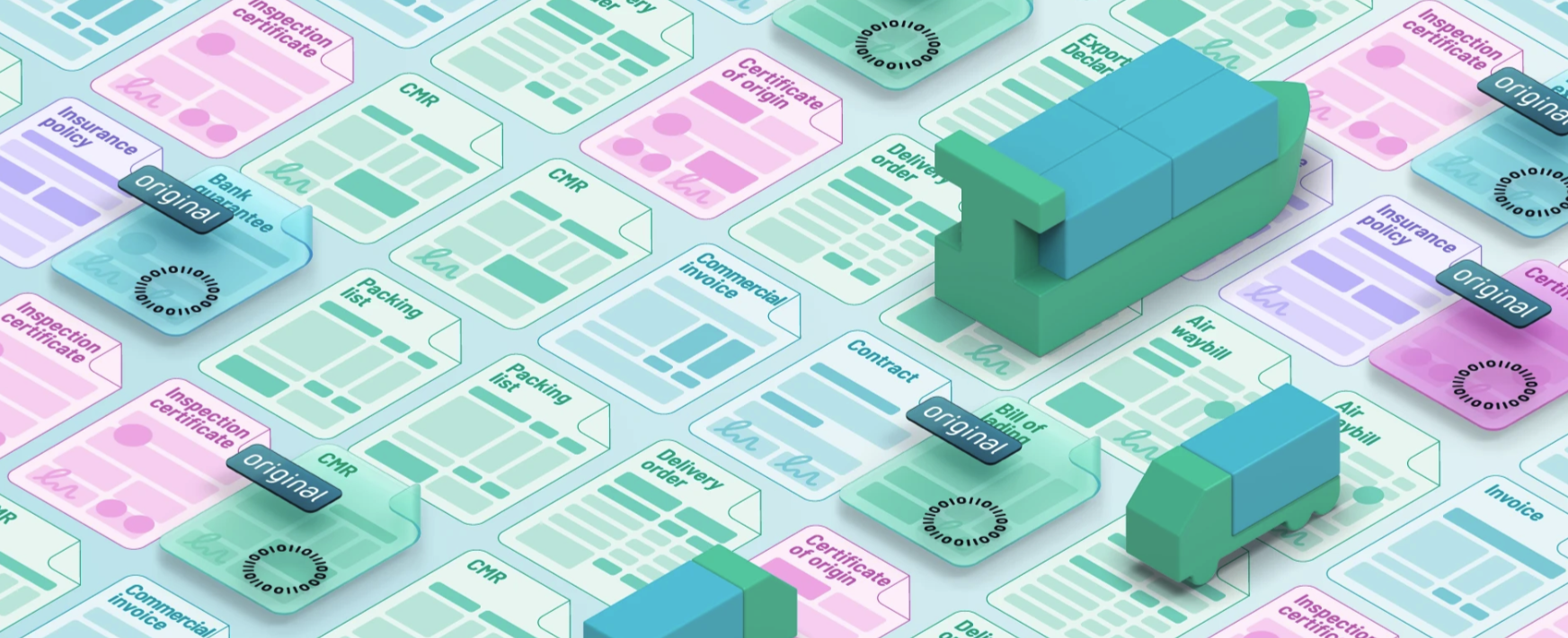
Key digital trade documents, data standards, and what they mean for SMEs
Digital trade documents make international trade faster, safer, and more efficient. Each document has a specific role, from ensuring security to keeping transactions compliant with regulations.
For these documents to actually work across different systems and trading partners, they also need to speak the same language, data-wise. That’s where data standards come in: frameworks like UN/CEFACT, the DCSA data standards for container shipping, and the ICC Digital Standards Initiative define common data elements and formats, so that information created in one system can be read, trusted, and acted on in another.
And the best part – all of them eliminate paper!
Here is an overview of the key digital trade document types you should know about, and their significance for your business.
Negotiable instruments:
Digital Bill of Exchange (dBE)
The dBE is a financial document that represents a binding promise to pay for the goods and the right to demand payment for delivered goods. This document keeps international trade on schedule.
Put simply, it’s a fully digital and legally binding agreement where the buyer commits to paying the seller at a specific time.
Also, the electronic Bill of Exchange (as it’s sometimes also called, eBoE) ensures that payment obligations are clear and enforceable, even across borders.
Electronic Promissory Notes
An electronic promissory note is a digital promise by one party to pay another a specified amount at a future date.
Electronic promissory notes are widely used in trade finance to secure payments for goods or services. It’s the sleek, digital version of an IOU, but legally binding and far more trustworthy.
Example: A startup wants to buy raw materials from a supplier but needs 90 days to pay. An electronic promissory note guarantees that the supplier gets their money on time, without unnecessary bank visits or paperwork.
Title Documents:
Electronic Bill of Lading (eBL)
One of the most important documents, the eBL, is a digital version of the traditional bill of lading. Acting as the VIP pass for goods in international trade, eBL proves ownership, acts as a contract between buyer and seller, and serves as a receipt – all without the hassle of paper.
eBLs enable instant transfer of ownership and faster customs clearance. Instead of waiting weeks for a physical bill of lading to travel across the world, an eBL gets the job done instantly, reducing fraud risk and keeping things moving fast.
Example: A logistics company sends an eBL to a buyer overseas to confirm the shipment details. The buyer can access it immediately, avoiding delays caused by courier services.
Electronic Warehouse Receipts (EWR)
EWRs are digital documents that represent ownership of goods stored in a warehouse.
They are used as collateral for loans or as proof of ownership in trade transactions.
Example: A farmer in Argentina stores soybeans in a warehouse while waiting for better prices. Instead of selling at a loss, they use the EWR to get a bank loan, keeping cash flow steady while they wait for the market to rise. It's an asset that helps businesses stay financially flexible, without moving an inch.
Certificates
Electronic Certificates of Origin (eCO)
Just like your passport proves who you are, eCO proves where the product was made.
Many countries require this to apply tariffs correctly or qualify for trade agreements.
With eCOs, there’s no need to send physical documents across the globe, and customs authorities can verify origin instantly. Learn how you can create digital original certificates here.
Example: An Italian fashion brand exporting handmade leather bags to Canada. Using an eCO, the brand confirms they’re 100% Italian-made, helping the brand qualify for lower import duties instantly.
Cargo Insurance Certificates
Cargo insurance certificate is a digital proof that goods are insured during transit against risks like damage or loss.
It provides assurance to both buyers and sellers that shipments are protected. If your goods get damaged, lost, or stolen, this document guarantees that you get compensated. Learn how you can create digital original certificates here.
Example: A medical equipment manufacturer ships its fragile goods across continents. If a storm damages the cargo mid-journey, the insurance will cover the losses, giving the exporter peace of mind.
Agreements and supporting documents
Electronic Letter of Credit (eLC)
Serving like a financial safety net for buyers and sellers who don’t know each other well, an eLC is a digital guarantee issued by a bank that ensures payment to the exporter once delivery conditions are met.
In other words, an eLC keeps everyone happy. The payment is guaranteed once the terms are met, all while eliminating piles of paperwork.
eLCs simplify and accelerate the traditional LC workflow by digitising documentation, automating verification, and integrating real-time tracking. They also reduce processing time and eliminate courier costs.
Example: A manufacturer in China agrees to produce custom furniture for a new boutique hotel in New York. The hotel owner doesn’t want to pay upfront, and the manufacturer won’t ship without assurance. So, the hotel uses an eLC to ensure payment is released to the furniture manufacturer only after shipment documents are verified digitally.
A digital bank guarantee (dBE) is the electronic version of a traditional bank guarantee — a binding commitment from a bank or financial institution to pay a beneficiary if the applicant (usually the buyer) fails to meet certain contractual obligations.
Traditionally, these guarantees are paper-based and take days (or even weeks) to issue, verify, and amend. But with digital guarantees, all of this happens in real time, with greater transparency and security.
Banks can issue, manage, and amend guarantees electronically, with all data being tamper-proof and time-stamped. This reduces the risk of fraud and speeds up trade, especially in large transactions or infrastructure projects.
Example: A construction firm in Egypt secures a digital guarantee from its bank to assure a South Korean equipment supplier that they’ll be paid if the buyer fails to make payments or deliver on the contract. The supplier verifies and accepts the guarantee online in minutes – no courier delays or physical paperwork required.
Digital guarantees also offer a clear audit trail and can easily be integrated into trade finance platforms, helping businesses and banks streamline compliance and risk management.
Electronic CMR (eCMR)
The traditional CMR (Convention on the Contract for the International Carriage of Goods by Road) is a standardised contract that outlines the responsibilities of the sender, carrier, and receiver when goods move across borders by truck.
The eCMR is the digital upgrade that provides real-time tracking, instant access to transport data, and greater security.
No more piles of paperwork, lost documents, or unnecessary delays. No need to wait for a paper copy to be signed and returned; all parties can instantly verify and approve the shipment through a secure digital system.
Example: A company in France ships fresh produce to the Netherlands. Instead of dealing with a physical CMR that might get lost or delayed, they use an eCMR, which allows instant updates, digital signatures, and real-time proof of delivery.
e-Invoice
An e-Invoice is a document that details the transaction between exporter and importer, including product descriptions, quantities, pricing, and terms.
It makes payments faster and record-keeping effortless. No more printing, scanning, mailing, or chasing down payments. e-Invoices are required for customs clearance and serve as proof of sale.
Example: An exporter sends an e-Invoice to a retailer in minutes, integrating directly into accounting systems for automatic processing. It’s instant, efficient, and impossible to “accidentally” misplace.
Packing List
The unsung hero of shipping, the simple packing list details exactly what’s inside a shipment (including packaging and arrangement), making customs clearance a breeze.
An electronic packing list helps customs officials verify shipments quicker. It also helps the recipients of goods with inventory management – without heaps of paper laying around or getting lost.
Example: A US company orders 500 LED screens from South Korea. The electronic packing list helps the customs officers verify the shipment’s contents swiftly, and ensures the importer that everything arrives as expected.
e-Signatures
Digital equivalents of putting pen to paper, e-Signatures are used to verify the authenticity and integrity of digital documents. They are legally binding and a lot more convenient, as they cut out unnecessary delays.
Also, e-Signatures ensure that documents, like contracts or invoices, are tamper-proof.
Example: A supplier in Singapore and a buyer in Canada agreeing on a deal at midnight. No couriers, no scanning, just a quick e-Signature exchange and the deal is locked in seconds.
Legal recognition of digital trade
To facilitate the digitalisation of trade, the Model Law on Electronic Transferable Records (MLETR) was developed by the United Nations Commission on International Trade Law (UNCITRAL).
MLETR serves as the foundational framework upon which other national laws have been modelled, including the Abu Dhabi Global Market (ADGM) regulations and the Electronic Trade Documents Act (ETDA) in the United Kingdom.
All of these legislations support digital trade by making it legal and safe to use electronic documents instead of slow, old-fashioned paper ones. They give legal recognition for the use of digital documents by:
- Providing legal certainty for electronic documents, such as bills of lading, warehouse receipts, and other important trade documents
- Establishing clear standards for proof of possession
- Creating mechanisms for cross-border recognition
- Supporting the practical implementation of digital trade systems
In other words, thanks to MLETR, digital documents are legally equivalent to paper ones in many countries.
To successfully venture on the new digital trade path, we first need to accept the truth – the shift towards electronic trade documents is not an easy one. There are hurdles along the way.
For example, MLETR is a model law, not an international treaty, which means it’s a template that countries can use to create their own laws. Also, countries adopt it individually. If a country decides to use the MLETR, they will adapt it to fit their specific legal system. So again, differences may crop up.
One thing is clear – adopting MLETR and ETDA is a big step we took on our way to modernising global trade.
Types of digital trade solutions
Not all digital trade solutions are the same. Some are closed systems/platforms, while others are open solutions. Let’s discuss the pros and cons.
Closed digital trade platforms
These platforms digitise documents but keep them within a controlled network. Access is limited to members, making interoperability with other systems a challenge.
For example, a logistics company joins a private blockchain-based trade network to issue eBLs. However, if their partners use a different system, they may still need paper documents, negating the benefits.
- Bolero Ecosystem – a multi-bank platform for electronic Bills of Lading (eBLs). It operates within a closed ecosystem, meaning only registered users can exchange and verify documents. Drawback: if your trade partner isn’t on Bolero, you’re out of luck.
- ICE Digital Trade (formerly essDOCS) – A big player in digital trade, used for eBLs, electronic warehouse receipts, and other trade documents. While it improves efficiency, it still requires all parties in a transaction to be on the platform, limiting broader interoperability.
- GlobalTrade Corporation (recently acquired by Komgo) – a multi-bank trade finance platform that offers hosted solutions for electronic Letters of Credit (LC) advising and helps banks deliver LC messages electronically to corporate clients.
- Contour Network – manages the entire end-to-end LCs workflow digitally, enhancing real-time visibility and reducing LC presentation times.
- WaveBL – A blockchain-based solution for eBLs. While more flexible than some older closed platforms, it still requires participants to use Wave BL’s specific system for document transfers.
- CargoX – a blockchain-based platform for eBLs and other trade documents, approved by the International Group of P&I Clubs (IG P&I). As with other closed platforms, all parties to a transaction need to be on CargoX for it to work end to end.
- Secro – an eBL provider also approved by the IG P&I, operating within the Covantis network for commodity trading. Same trade-off: your counterparties need to be on the network too.
- BRITC – an eBL platform run by eTrade Solution and approved by the IG P&I, used mainly within its own member network.
To sum up, generally these platforms lock businesses into their networks. If you’re trading with partners who use a different system, you might still end up dealing with paper, defeating the purpose of going digital.
Open digital trade solutions
Open solutions allow businesses to create, manage, and share digital-native trade documents without being locked into a single system. Documents remain tamper-proof, legally valid, and transferable across borders.
One key advantage is interoperability, meaning documents can be used and recognised across different platforms and systems without compatibility issues. This ensures smoother trade operations even when partners use different technologies.
For example, a small seafood exporter in Norway uses an open solution to issue a digital bill of lading. Their buyer in Japan, who uses a different system, can still verify and accept it, keeping the trade process fully digital.
Enigio is known as the open network for electronic trade, thanks to its patented trace:original solution. Only the creator of the document needs to sign up and pay for the service. You can send to anyone else with no need for onboarding or any special programme or software. Easy!
trace:original also works with blockchain and secure cryptography, and you can follow the full audit trail of the document in the public ledger. But you never need to share your data with any third-party system – you're always in full control.
How to get started with digital trade documentation
Adopting digital trade documentation may seem daunting, but with a structured approach, your business can transition smoothly.
Let's break down the adoption of digital trade documents into 7 easy-to-follow steps.
1. Assess your needs
First and foremost, you need to be realistic and weigh all pros and cons. So, start by identifying which trade documents you use most often. Are you dealing with bills of lading, invoices, or letters of credit? Do you only need to digitise one type of document, or, thinking long-term, will you want to digitise your full process and all parts? Understanding your workflow will help determine which digital solutions will provide the most immediate benefits.
2. Check legal and regulatory requirements
Not all countries or trade partners have fully adopted digital trade laws. Check whether electronic documents are legally recognised in your target markets. The UK's Electronic Trade Documents Act and the Model Law on Electronic Transferable Records (MLETR) are paving the way for broader acceptance, but regulations still vary globally.
Some solutions, like Enigio’s trace:original, offer unique “change-to-paper" functionality so that you can still create your documents digitally, but switch it over to a paper original if necessary at any moment in the transaction.
3. Choose the right solution
Decide between a closed system (where all parties must be on the same network) or an open, interoperable solution, which ensures your documents can be used across different platforms. Open systems prevent vendor lock-in and stimulate more flexible trade relationships.
For example, trace:original is an open digital trade solution. This means anyone can implement and start using trace:original for issuing all digital originals. A computer and internet connection is all you need. It is only the one creating the digital original document that needs to be a customer of Enigio.
4. Upgrade your internal processes
Digitisation isn’t just about replacing paper with PDFs. It’s a total revamp of the way your business operates. That’s why you need to make sure your employees are comfortable with this change. It’s a good ideal to train your team on new digital workflows, integrate digital documentation with your existing ERP or trade management system, and ensure that your IT infrastructure is secure.
5. Educate your trade partners
A smooth transition to digital trade documentation requires collaboration. Work with suppliers, buyers, banks, and logistics providers to ensure they also understand and support digital documents. If necessary, introduce them to open platforms that facilitate wider adoption.
6. Run a pilot project
It's not bad to start small! In fact, choosing one area to focus on initially can be a great way to ensure success down the road.
Before committing fully, test digital trade documentation with a small batch of transactions. Choose a trusted trade partner willing to participate and analyse how digital processes affect efficiency, costs, and transaction times. It’s an invaluable experience that will help you find the right digitalisation path faster.
7. Monitor, improve, and scale up
Once your pilot project proves successful, expand the use of digital documentation across your operations. Monitor for any challenges, optimise workflows, and take advantage of new digital trade laws and innovations as they emerge.
Key takeaways:
- Digital trade documentation is the future.
It eliminates delays, reduces costs, and increases security in global trade transactions.
- Electronic Bills of Lading, Invoices, and Certificates of Origin are just a few key documents that can be digitized for faster and more efficient trade.
- Closed platforms limit flexibility, while open solutions like trace:original offer true interoperability, ensuring smoother transactions across different systems.
- Adopting digital trade documentation requires planning.
Businesses should assess their needs, understand legal requirements, and choose the right platform for seamless integration.
- Collaboration is crucial.
Ensuring trade partners, banks, and logistics providers support digital documentation will maximize efficiency and eliminate unnecessary paperwork.
- Start small, scale fast.
Running a pilot project and refining processes before full-scale implementation ensures a successful transition.